
Leave Your Message
Engineered to deliver high volumetric efficiency and zero-drift positioning in harsh excavation and earthmoving environments.
Navigating modern power transmission requirements across mining, excavation, and industrial civil engineering.
Modern construction, mining, and earthmoving projects operate under relentlessly demanding environments. From deep tunneling and mass earthworks to high-rise building erection, machinery must exert enormous break-out forces while sustaining micro-level positioning accuracy. At the very center of this massive physical mechanical output lies fluid power: advanced Hydraulic Components For Construction And Earthmoving Machinery.
Historically, heavy civil equipment prioritized gross force output over hydraulic efficiency. However, escalating diesel fuel expenditures, stringent international carbon emissions mandates (such as US EPA Tier 4 Final and EU Stage V), and the integration of autonomous operation have shifted industry requirements. Original Equipment Manufacturers (OEMs) and precision aftermarket engineering suppliers now emphasize total volumetric efficiency, parasitic drag reduction, compact multi-axis integration, and long lifecycle tribological performance under extreme cycle shocks.
Standard construction hydraulic circuits have shifted from 210 bar up to continuous 350-420 bar ratings, demanding higher yield cold-drawn tubing, induction hardened chrome plating, and failure-proof containment flanges.
The merging of digital proportional controls, intelligent valve blocks, and embedded linear displacement transducers ensures synchronized multi-boom kinematics and rapid autonomous cycle execution.
With fine-clearance directional control spools and multi-stage telescoping sleeves, innovative composite rod wear rings and multi-lip polyurethane seal configurations mitigate abrasive grit ingress.
In earthmoving fleet procurement, a single unplanned hour of hydraulic failure on an excavator or heavy wheel loader can cost project operators thousands of dollars in stagnant logistics and project penalties. Consequently, major contractors focus heavily on Total Cost of Ownership (TCO). High-precision manufactured hydraulic components—featuring precision-honed barrels with low surface roughness (Ra < 0.2 μm), micro-alloyed forged steel bases, and CNC-machined counterbalance manifold blocks—substantially prolong Mean Time Between Failures (MTBF). By eliminating external hydraulic leakages and mitigating internal thermal dissipation, contractors maintain peak hydraulic conversion metrics across thousands of continuous service hours.
How specialized hydraulic cylinders, custom manifolds, and structural bushings perform under severe mechanical stresses.
Excavator booms, sticks, and buckets endure severe cyclic shock loads when encountering bedrock or frozen topsoil. Boom and bucket cylinders require high-integrity welded or tie-rod structural architectures, cushioned end-stroke deceleration sleeves, and load-holding counterbalance valves to prevent catastrophic collapse upon hydraulic pressure line rupture.
Mobile rough-terrain and crawler cranes rely strictly on outrigger systems for structural stabilization before lifting multi-ton counterweights. Outrigger hydraulic cylinders must maintain zero volumetric drift over prolonged holding periods under high static loads, supported directly by integrated pilot-operated check valves and counterbalance cartridges.
Operating inside restricted tunnels with high humidity, acidic ambient drainage, and constant airborne rock dust, LHD machines demand ultra-compact hydraulic geometries. Tilt and steering cylinders incorporate hardened nitrocarburized or dual-layer chrome-plated rods to resist mechanical scouring and moisture-induced pitting.
Personnel lift machinery demands the utmost level of fluid safety and velvet-smooth proportional speed regulation. Telescopic multi-stage cylinders and platform leveling actuators operate in tandem through electro-proportional valve banks to maintain basket horizontal orientation regardless of main boom elevation or chassis incline.
Next-generation advancements driving the smart, sustainable fluid power revolution.
With global equipment manufacturers rolling out battery-electric mini-excavators and electric wheel loaders, hydraulic systems are moving away from traditional internal combustion engine belt-driven pumps. Modern architectures incorporate variable-speed electric motors paired directly with compact, displacement-controlled hydraulic circuits. This architecture demands hydraulic cylinders and manifold assemblies that exhibit ultra-low internal leakage and negligible idle drag, preserving battery runtimes while maintaining maximum hydraulic breakout torque.
The convergence of predictive condition monitoring and industrial hydraulics has introduced smart cylinders fitted with internal magnetostrictive position sensors, load cells, and temperature transducers. These digital sensors stream real-time stroke position, dynamic pressure spikes, and oil degradation metrics directly to machinery control units (ECUs). Automated algorithms detect seal micro-weeping and spool contamination long before visible field failures occur, reducing sudden field downtime to near zero.
Severe environmental regulations have spurred a shift away from traditional hexavalent hard chrome electroplating toward High-Velocity Oxygen-Fuel (HVOF) thermal spray coatings and advanced plasma nitriding. These advanced metallurgical treatments yield piston rods with superior microhardness (exceeding 60 HRC), extreme salt spray resistance (>1000 hours ASTM B117), and reduced coefficient of friction against high-pressure polyurethane and PTFE dynamic lip seals.
Complex hydraulic piping systems in modern equipment are increasingly replaced by consolidated hydraulic manifold blocks manufactured from solid ductile iron or aerospace-grade aluminum. Precision CNC deep-hole drilling minimizes flow-path turbulence, eliminates external tubing connections, drastically reduces leakage failure points, and shrinks the total installation envelope inside cramped engine compartments.
Tolerances that define reliability: inside precision machining of cylinders, heads, bases, and manifolds.
True field reliability is established on the factory floor through micron-accurate manufacturing tolerances. A hydraulic cylinder is only as robust as the mechanical synergy between its primary parts:
Complete fluid power product line for construction machinery builders, service providers, and OEM rebuilders.


Examine specialized actuators customized for sanitation, underground tunneling, and telescoping equipment.

A critical hydraulic component in sanitation vehicles, used to securely lock and release compartments or compacting mechanisms. With a compact design and high load capacity, it ensures stable operation under heavy-duty conditions, enhancing safety and efficiency.

Serves as a critical hydraulic actuator within Load-Haul-Dump (LHD) machines, designed to precisely control the tilting and dumping motions of the bucket or load compartment for efficient material discharge in confined underground spaces. Fabricated from high-strength steel with protective coatings to withstand extreme pressure and shock loads.

Actuates the raising, lowering, and tipping movements of the refuse compartment or compaction system. Provides strong corrosion resistance, durable load-bearing performance, and a robust sealing mechanism engineered to operate reliably in demanding municipal environments.

A multi-stage sleeve hydraulic actuator consisting of a main cylinder and four-stage movable sleeves nested in sequence. Under fluid pressure, the sleeves extend smoothly in sequence to deliver extended operational reach from an exceptionally compact retracted footprint.

Widely deployed across engineering machinery, aerial work platforms, and cranes. Its three-stage telescopic architecture achieves a large telescopic stroke within restricted physical installation space, satisfying rigorous performance demands across variable boom angles.

Controls the swinging motion of working arms to achieve multi-angle operating coverage. Converts hydraulic power into continuous mechanical swinging motion, serving as an indispensable actuator for stability under complex operating conditions.

The core hydraulic actuator for aerial platforms, used to govern the pitch angle of the main boom. Facilitates stable lifting, lowering, and elevation angle adjustments for precise platform positioning.

Delivers sequential extension and retraction for boom structures. Driven by optimized hydraulic circuits to ensure smooth displacement and reliable target elevation under full rated workload.

Key hydraulic actuator for automated or operator-guided chassis and basket leveling on uneven terrain, safeguarding overall machinery stability throughout heavy lifting cycles.
Fundamental hydraulic principles powering construction engineering excellence.

Pressure compensating valves automatically adjust spool metering orifices to maintain constant flow rates regardless of shifting load pressures. In multi-actuator earthmoving systems, this prevents faster cylinders from robbing fluid power from heavier-loaded circuits, securing predictable simultaneous operations.

Industrial lift cylinders convert fluid pressure into linear thrust through double-acting or single-acting displacement. Integrating internal cushioning collars minimizes hydraulic shock peaks at stroke termination, preventing structural fatigue across heavy machinery chassis.

Boom cylinders form the primary lifting muscle for excavators, backhoes, and mobile cranes. Operating under both positive tension and negative over-center loads, they rely on integrated counterbalance valves to govern descent speeds without pump cavitation.
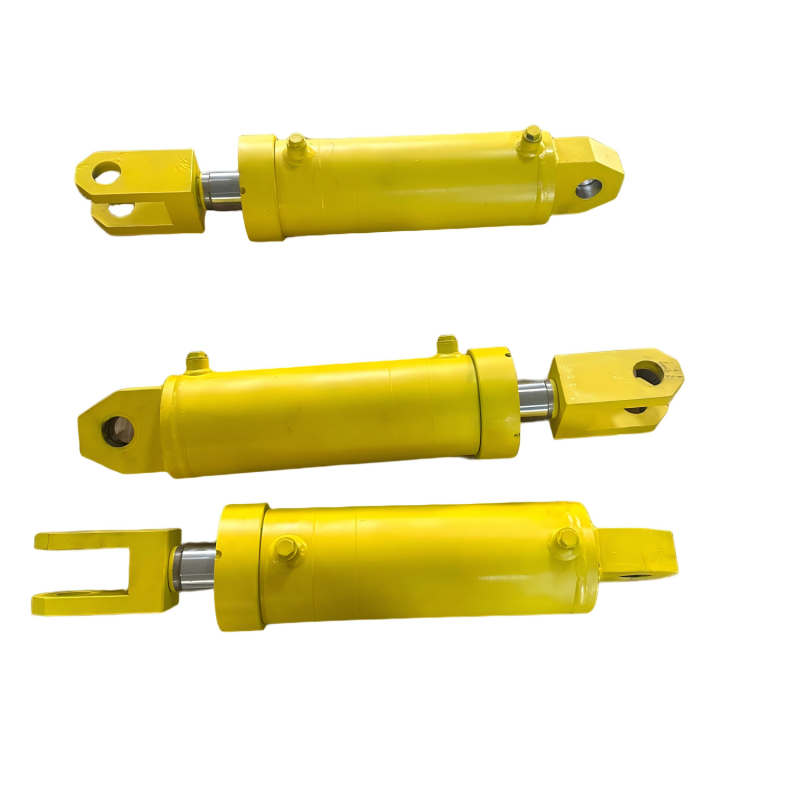
Selecting between single-acting (gravity or spring return) and double-acting hydraulic cylinders depends on operational requirements. While single-acting designs serve simple tipping or clamping, double-acting cylinders provide controlled power in both directions, making them essential for complex excavator booms and outriggers.
Advanced CNC machining centers, precision cylindrical grinding, and ISO-certified fluid assembly facilities.


